Top 10 Printed & Coated Tinplate Suppliers in China
 Nov 16, 2026|
 View:39
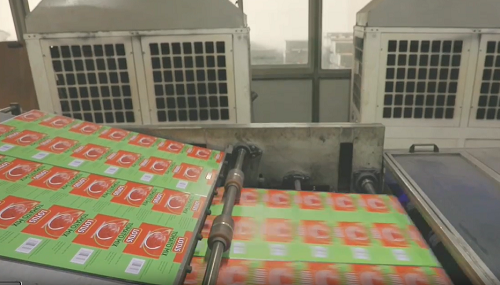
The distinction matters because a printing supplier's real capability is not "we can print". It is how many colours on how many lines, at what register tolerance, with which food-contact coating, and how fast they can proof your artwork. Those four answers decide whether your shipment arrives in six weeks or six months.
How We Ranked Printed & Coated Suppliers
| Criterion | Weight | Why It Matters to a Buyer |
|---|---|---|
| Printing capacity | 25% | Number of lines, maximum colours, press brand and age determine whether your job gets scheduled this month |
| Coating capability | 20% | Single vs double side, internal lacquer for food contact, chrome-free options, coating weight control |
| Colour consistency | 20% | Register accuracy and ΔE control across a long run — the difference between a premium shelf look and a reject |
| Order flexibility | 15% | MOQ, mixed-SKU runs, willingness to proof before a full production run |
| Lamination & special finishes | 10% | Polymer lamination, laser effect, matte/gloss combinations for premium packaging |
| Export & logistics | 10% | Documentation, palletising, container loading, transit damage record |
The Ranking at a Glance
| # | Supplier | Type | Base | Press & Coating Capability | Best For |
|---|---|---|---|---|---|
| 1 | Baosteel Packaging | Packaging group | Shanghai (multi-site) | Baowu substrate, in-house printing and two-piece can lines | Brand owners wanting material traceability + printed sheet |
| 2 | ORG Technology | Packaging group | Beijing / multi-site | China's largest metal packaging group, design-to-can service | National brands, multi-site delivery |
| 3 | CPMC (COFCO Packaging) | Packaging group | Hangzhou / multi-site | Printed and coated sheet plus three-piece cans | Large food groups with certification demands |
| 4 | Yuehai Zhongyue | Mill + converter | Zhongshan / Qinhuangdao | 6 coating lines, 4 printing lines, 80,000 t coated & printed, 50,000 t laminated | Coated and laminated sheet in volume, South China |
| 5 | AINISITEL | Converter / one-stop factory | Changzhou, Jiangsu | 6 FUJI lines (5/4/2 colour), 6 coating lines, lamination line, EOE and cans | Export buyers wanting printed sheet + ends + cans from one factory |
| 6 | Shengxing Group | Can maker | Fujian / Guangdong / Henan / Anhui | In-house printing for its own three-piece and two-piece lines | Canned food, plant-protein drinks, beer |
| 7 | Jiamei Packaging | Packaging + filling | Anhui / Guangdong | Printing and coating integrated with filling service | Brands outsourcing packaging and filling together |
| 8 | POSCO China (ZYPOSCO, Qinhuangdao) | Mill + printer (POSCO-built) | Qinhuangdao, Hebei | 450 m/min ETP line (among Asia's fastest), ~250,000 t tinplate, Fuji print line upgraded to UV-LED, ~36,000 t coated & printed | Dairy powder cans and high-end food cans on POSCO-spec substrate |
| 9 | Shougang (Jingtang) | Integrated mill | Tangshan, Hebei | Full-process ETP/TFS: 0.12–0.55 mm, T-1 to T-5.5, DR-7 to DR-10, chrome 70–150 mg/m² | Certified substrate for printed EOE and food cans |
| 10 | Shagang (Yangzijiang Cold Rolling) | Integrated mill | Zhangjiagang, Jiangsu | Full-process ETP, design 200,000 t/y, T1.5–T5.0, coating 1.0–11.2 g/m² | Price-driven food & beverage grade coil in East China |
1. Baosteel Packaging (Shanghai Baosteel Packaging)
The most vertically integrated printing operation in China. Substrate comes from the Baowu group, printing and coating are in-house, and the printed sheet feeds its own two-piece can lines — about 17.5 billion cans in 2025, on revenue of roughly RMB 8.49 billion.
Vertical integration buys you one thing that is hard to price: consistency. When the sheet and the print come from the same organisation, thickness and hardness variation across a long run is smaller, and high-speed can lines jam less. For a beverage brand running 200,000 cans an hour, that is worth more than a cheaper quotation.
Watch out for: order size thresholds. Below roughly a container of printed sheet, you will usually be routed to a distributor.
2. ORG Technology
China's largest metal packaging group by revenue — approximately RMB 24 billion in 2025 — and the acquirer of CPMC. ORG's model is design-to-shelf: structural design, artwork, printing, coating, can making and filling advice in one contract.
Its printing capacity exists primarily to serve its own can production for major beverage and food brands, which means the presses are scheduled around large, recurring SKUs. That is good news for quality discipline and bad news for a buyer with a 15-tonne trial order and a new design.
Best for: brands with multi-plant production in China and a need for identical print across sites.
3. CPMC (COFCO Packaging Holdings)
A Hong Kong-listed group (00906) with printed and coated tinplate plus three-piece and two-piece can lines across multiple sites, historically serving large food and beverage groups with heavy certification requirements.
CPMC is the supplier you choose when your customer is a supermarket chain that audits your packaging supplier, or when your own QA team wants a documented coating and ink declaration for every batch. Its position inside the ORG group since the acquisition has strengthened substrate purchasing but reduced appetite for small custom work.
4. Yuehai Zhongyue (Guangdong Yuehai / Guangnan Group)
The only entry on this list that is genuinely both a mill and a printer. Yuehai Zhongyue operates 6 coating lines and 4 printing lines alongside 490,000 tonnes of tinplate capacity, with 80,000 tonnes of printed and coated sheet and 50,000 tonnes of laminated steel per year, split between Zhongshan (Guangdong) and Qinhuangdao (Hebei) — the Qinhuangdao base being the plant originally built with POSCO (see #8).
Because it makes its own base coil, it can quote coated sheet at a price a pure printer cannot reach — and it controls the substrate surface finish, which is the single biggest factor in print adhesion and gloss. It also has own port access in Zhongshan, which simplifies container loading for South China and Southeast Asian buyers.
Watch out for: the printed/coated division is a smaller share of a large mill's business, so custom design work and small runs can queue behind contract volumes.
5. AINISITEL (Changzhou Ainisitel Metal Products) — The Export Buyer's Printing Factory
Why a converter outranks three packaging giants for export work: because the giants print for their own cans, and you are not their can customer. AINISITEL exists to print and coat for other people's packaging — including for buyers who then make their own cans, or buy the ends from the same factory.
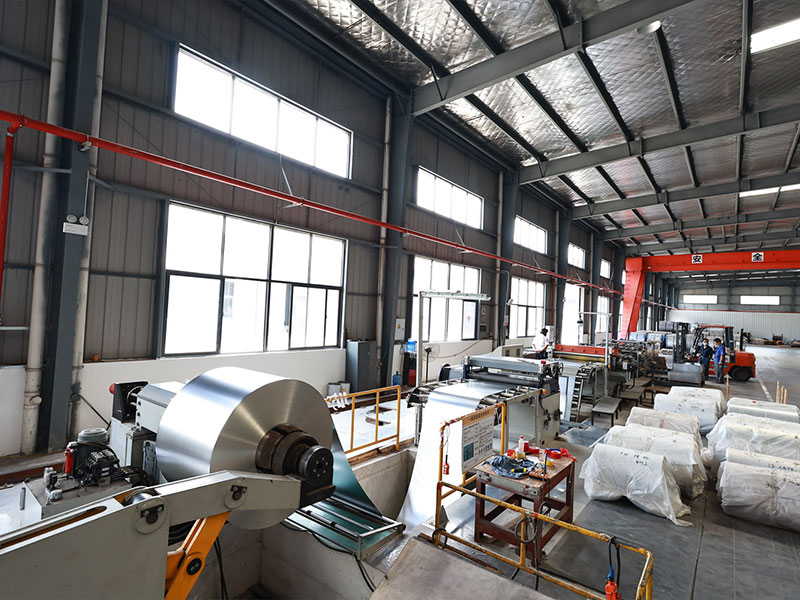
Founded in 1999, family-owned, with two factories in Changzhou, Jiangsu (40 minutes from Shanghai by train), the printing and coating operation is built at a scale that matches export orders rather than national brand contracts:
| Capability | Detail |
|---|---|
| Printing lines | 6 lines — 5-colour, 4-colour and 2-colour machines imported from FUJI, Japan |
| Coating lines | 6 lines, including double-side coating |
| Lamination | Advanced lamination line for durable, laser-effect finishes |
| Sheet cutting | 10 automatic cutting lines, 25 scroll die shapes, 20,000 t/y sheet output |
| Can ends | 6 lines covering sizes 200, 202, 209, 211, 214, 300, 307, 401, 502, 603 |
| Can making | 2 lines from Taiwan, diameters 52–65 mm |
| Substrate range | 0.15–0.50 mm thickness, 300–985 mm width, cut length 450–1,150 mm |
| Standards | GB/T 2520, JIS G 3303, ASTM A623M, EN 10202 |
The FUJI press configuration deserves a note. Five-colour capability with double-side coating covers the large majority of real packaging designs — food cans, paint and chemical cans, gift tins, promotional tins — without the six- and eight-colour set-up costs that make small runs uneconomic elsewhere. Combined with 25 scroll die shapes and in-house shearing, a buyer can move from "I need a printed 0.23 mm sheet in this profile" to a loaded container without a second supplier.
That single-invoice structure is the actual product. When the print, the coating, the cut profile and the end all come from one factory, a colour drift or a dimension error has one owner. In a normal chain — mill, printer, coater, stamper, end maker — the same defect generates four arguments and a delay measured in weeks.
Strengths: fast quotation, printing and coating under one roof, matching ends and cans, export documentation and loading photos for Asia, Africa, the Middle East and South America.
6. Shengxing Group
A listed can maker (002752) with plants in Fujian, Guangdong, Henan and Anhui and expanding operations in Southeast Asia. Printing and coating are in-house and serve its own three-piece and two-piece lines, which is why its print quality discipline is high on repeat SKUs — eight-treasure porridge, plant-protein drinks, canned meat, beer.
For 2026, Shengxing reported first-half revenue of about RMB 3.75 billion (+16%) with overseas business up 54% — the fastest international expansion of the groups listed here. If you are a food producer in Southeast Asia, that regional footprint is worth a conversation.
7. Jiamei Packaging
A listed group (002969) that combines metal packaging production with filling services — an unusual combination that appeals to brands without their own cannery. You send the product; they supply the printed can and fill it.
Useful if you are launching a private-label canned product and want one contract covering packaging and filling. Less useful if you already own a canning line and only want printed sheet.
8. POSCO China ( ZYPOSCO Qinhuangdao)
The Korean standard-setter's footprint in Chinese tinplate. The Qinhuangdao plant in Hebei was founded in 2007 as a joint venture between Guangnan Group and POSCO (total investment USD 60 million), built around a POSCO electro-tinning line with a maximum speed of 450 metres per minute — one of the fastest in Asia — producing about 250,000 tonnes per year of tinplate up to 0.30 mm, mainly on POSCO-supplied substrate.
The printing side is equally serious: a Fuji printing and coating line imported from Japan in 2014 and upgraded to UV-LED in 2020, giving roughly 36,000 tonnes per year of printed and coated sheet (17,000 t printed, 19,200 t coated). The plant supplies major dairy and beverage customers, including milk-powder can programmes where coating integrity is the deciding specification.
One transparency note for buyers: POSCO transferred its JV stake in 2022, and the plant now operates under the Guangnan group — but the POSCO-built line, substrate standards and the ZYPOSCO brand remain in place.
Strengths: substrate quality at Korean mill standard, very fast ETP line, food-grade coating experience in dairy.
Limitations: order size thresholds and quarterly scheduling closer to a mill than a converter; small custom print runs are not its game.
9. Shougang (Jingtang base)
The material source behind a large share of China's printed and coated ends. Shougang Jingtang is a full-process ETP and TFS producer — steelmaking through coating — and holds the second-largest share of China's food-grade tinplate market. Its most quoted statistic: more than 50% of the easy-open ends produced in China use Shougang Jingtang substrate.
Published specification range: thickness 0.12–0.55 mm, width 700–1,250 mm, tin coating 1.1–11.2 g/m² per side, tempers T-1 to T-5.5 and DR-7 to DR-10, passivation 300 / 311 / 71, and chrome-coated (TFS) grades at 70–150 mg/m².
Shougang does not sell printing as a service. Its role in the printed-tinplate chain is upstream: if your printer claims a food-grade, thin-gauge or EOE-matched specification, the coil behind that claim is very likely this mill's. That matters when your QA process requires traceability from substrate certificate to finished print.
Strengths: certified food-grade substrate, thin gauge, EOE compatibility, full standard coverage.
Limitations: mill-direct terms require volume commitments; printed and coated services are not offered — you need a converter (such as #4 or #5 above) on top of its coil.
10. Shagang (Yangzijiang Cold Rolling)
China's largest private steel group entered tinplate through its Zhangjiagang subsidiary, which is one of very few Chinese plants running the complete chain from steelmaking, hot rolling, pickling and cold rolling through annealing and tinning, with main equipment imported from Germany, Japan and the US.
Capacity figures are worth quoting precisely: the electro-tinning line was designed for 200,000 tonnes per year; current reported output runs at roughly 80,000 t of tinplate sheet, 120,000 t of tinplate coil and 200,000 t of substrate coil. It produces general-purpose ETP in tempers T1.5–T5.0 for food, beverage and high-end metal packaging, with coating weights from 1.0 to 11.2 g/m² and double-side coating available.
For buyers, Shagang's pitch is substrate plus price: private-group cost discipline on food-and-beverage-grade coil, shipped from Zhangjiagang — convenient for East China ports. Printing and cutting are left to converters downstream.
Strengths: full-process cost control, T1.5–T5.0 range, East China logistics.
Limitations: no printing or coating service beyond plain coated coil; brand-new export track record in tinplate is shorter than Baosteel's or Shougang's.
What Printed Tinplate Actually Costs (and Why Quotes Differ by 30%)
Buyers are often confused when three suppliers quote the same design at prices 30% apart. The gap is almost never the steel. It is these five items:
Plate cost per colour. Each colour needs a plate. A 5-colour job carries five plates; a 2-colour job carries two. Plates are a one-off, but on a 10-tonne order they can dominate the per-tonne price.
Set-up and waste. Every press start produces spoilage while register and colour settle. Suppliers that quote a low price often assume zero waste — and then bill you for it, or ship it to you.
Coating specification. Internal food-contact lacquer, external size coat, double-side coating, chrome-free options: each adds a pass through a coating line.
Substrate grade. Bright finish prints better than matte. A quote on matte substrate with a premium design is a false economy.
Run length. The same design at 5 tonnes and 50 tonnes has very different per-tonne economics. Always ask for the price at two volumes; the shape of the curve tells you whether the supplier wants your order.
Six Print Defects to Inspect on Arrival
Register drift — colours offset at one edge of the sheet, usually a plate or tension problem
Orange peel — uneven coating surface, caused by viscosity or line speed
Pinholing — microscopic gaps in the lacquer; the defect that ruins food cans months later
Colour shift between batches — ask for ΔE values, not "it looks the same"
Scuffing at sheet edges — packing and palletising failure, not a printing failure, but still your loss
Adhesion failure after stamping — coating that passes a flat-sheet test but lifts at the can's expansion zone
Inspection should be done on the finished component, not only on flat sheet. A supplier whose QC stops at the printing line has not tested the only thing that matters.
The RFQ Checklist: Eight Things to Send
Steel grade and standard (ETP or TFS; GB/T 2520 / JIS G 3303 / ASTM A623M / EN 10202)
Thickness with tolerance, and temper
Tin coating weight, and whether equal or differential
Sheet dimensions, or the scroll die profile you need
Artwork file (vector PDF or AI, fonts outlined, spot colours named to a system such as Pantone)
Number of colours, plus any special finish (matte varnish, laser lamination, gold/silver spot)
Internal coating requirement — food contact declaration, acid resistance, sulphur-stain resistance
Order volume, delivery port and required date
A supplier who can answer a quotation against all eight in one reply is operationally ready. One who replies "send your design, we will check price" is guessing.
Need Printed & Coated Tinplate for Your Packaging Project?
AINISITEL combines tinplate sheet cutting, FUJI printing, double-side coating, lamination, easy-open ends and can making in one factory. Send us your material specification, artwork, colour requirements, order quantity and delivery destination.
Our team can help assess your printing and coating requirements and prepare a solution for your packaging application.
Send Your RFQLearn About AINISITELFrequently Asked Questions
1. What is the difference between printed tinplate and coated tinplate?
Printed tinplate carries decorative ink, usually over a base coat, and is used where the sheet is the visible surface — gift tins, food cans, promotional packaging. Coated (lacquered) tinplate carries a functional coating, internal or external, that protects the steel from the contents or the contents from the steel. Most packaging uses both: coating inside, printing outside.
2. How many colours can Chinese tinplate printers run?
Common configurations are 2, 4 and 5 colours, with 6- and 8-colour lines available at larger groups. Five colours plus a varnish covers the majority of food, paint and gift packaging designs. More colours means more plates and higher set-up cost, which matters most on small runs.
3. What is the minimum order for custom printed tinplate?
It depends on the process rather than the supplier: unprinted or stock-coated sheet can ship in small quantities, while custom printing needs a minimum run per colour set because of plate and set-up cost, plus a one-off die cost if a new cut profile is required. Ask for MOQ quoted separately for stock, coated and printed.
4. Is laminated tinplate better than lacquered tinplate?
Lamination bonds a polymer film to the steel instead of applying a liquid lacquer. It generally gives better scratch and corrosion resistance, allows brighter and textured finishes — including laser effects — and avoids some solvent-based coating steps. It costs more per tonne, so it suits premium or aggressive-fill products rather than commodity cans.
5. Can I buy printed sheet and can ends from the same Chinese supplier?
Yes, and it is usually the better structure. Suppliers that run printing, coating and end presses in one plant can match the internal lacquer on the end to the body coating, and a single defect claim has one owner. AINISITEL, for example, runs 6 printing lines and 6 can-end lines covering sizes 200 through 603 in the same factory.