Top 10 Tinplate Manufacturers in China 2026
 Nov 12, 2026|
 View:38
China's effective tin- and chrome-coated steel capacity reached roughly 10.98 million tonnes in 2025, with the top five producers holding about 78% of the market. Capacity is not the constraint any more — product mix, certification and export logistics are.
This guide ranks the ten manufacturers that appear most often in real export enquiries, explains what each one is actually good at, and ends with a nine-point checklist you can use before you send a deposit.
How We Ranked
Five weighted criteria, scored 1–5:
| Criterion | Weight | What It Measures |
|---|---|---|
| Production capacity & consistency | 30% | Annual tonnage, number of lines, ability to repeat the same temper and coating order after order |
| Product breadth | 20% | ETP, TFS, thickness range, temper range, coating weight range, downstream services |
| Export readiness | 20% | Export documentation, port access, container loading capability, experience with Asia/Africa/Middle East/South America |
| Quality system | 15% | QC per process, lab testing, standard compliance (GB/T 2520, JIS G 3303, ASTM A623M, EN 10202) |
| Responsiveness & MOQ | 15% | Quotation speed, sample turnaround, willingness to run small or mixed orders |
A 500,000-tonne mill and a 20,000-tonne converter cannot be judged on the same scale. That is why the table below separates Type: mills sell material, converters sell finished packaging components.
The Ranking at a Glance
| # | Company | Type | Base | Core Strength | Best For |
|---|---|---|---|---|---|
| 1 | Baosteel (Baowu) | Integrated mill | Shanghai / Wuhan / Nanjing | Largest ETP producer in China, ~800,000 t/y design capacity | High-end food, beverage and aerosol cans |
| 2 | Shougang Jingtang | Integrated mill | Tangshan, Hebei | Supplies over half of China's easy-open-end substrate | EOE stock, DI material, thin gauge |
| 3 | Yuehai Zhongyue | Integrated mill + converter | Zhongshan, Guangdong / Qinhuangdao | 490,000 t tinplate, 80,000 t printed & coated | South China sourcing, coated and laminated |
| 4 | Angang Steel | Integrated mill | Anshan, Liaoning | Cost-competitive general grades at steel-mill scale | Large-volume commodity ETP |
| 5 | AINISITEL | one-stop factory | Changzhou, Jiangsu | Professional Tinplate & TFS Supplier | 20 Years of Experience | 10,000-Ton Standing Stock | Full-Chain Integrated Supply | Buyers wanting coil-to-can from one supplier, dispatch from stock in as fast as 3 days |
| 6 | HBIS Group | Integrated mill | Tangshan / Handan, Hebei | High-volume general and mid-grade tinplate | Price-driven tenders |
| 7 | WISCO (Wuhan Iron & Steel, Baowu) | Integrated mill | Wuhan, Hubei | Baowu's Wuhan tinplate base + WISCO-Nippon Steel JV for high-end food-grade | High-end food-grade ETP from the Baowu network |
| 8 | Baosteel Packaging | Packaging group | Shanghai (multi-site) | Baowu substrate + printing + two-piece cans | Brand owners buying cans and printed sheet together |
| 9 | Masteel (Maanshan Iron & Steel) | Integrated mill (Baowu) | Ma'anshan, Anhui | Food-grade tinplate substrate and closure stock, East China base of the Baowu network | Bottle caps, closures and food-can substrate in East China |
| 10 | Fujian Ton Yi Tinplate | Mill + printer (Taiwan JV) | Zhangzhou, Fujian | ~150,000–200,000 t/y ETP, TFS line, Fuji two-colour printing & coating since 2000 | Food cans and three-piece beverage cans, Fujian / South China |
1. Baosteel (Baoshan Iron & Steel, China Baowu)
The benchmark for high-end ETP in China.
Baosteel is the country's largest electrolytic tinplate producer, with a design capacity of roughly 800,000 tonnes per year (2025) across its Shanghai Baoshan, Wuhan Qingshan and Nanjing Meishan bases. Its tin coating uniformity is controlled to about ±1.5 g/m², and its product qualification rate is reported at around 98.5%.
What makes Baosteel different is the customer mix it serves: food cans, beverage cans, milk powder cans and aerosol containers — categories where a single coating defect means a recall. It also runs a joint venture with Nippon Steel (WISCO-Nippon Steel) dedicated to high-end food-grade tinplate, and can produce ultra-thin 0.12 mm material.
Strengths: metallurgical consistency, full standard coverage, technical support.
Limitations for exporters: minimum order quantities are high, lead times are planned quarterly, and small mixed orders are usually redirected to distributors or converters. If you need 5 tonnes of printed sheet, this is not your supplier.
2. Shougang Jingtang (Shougang Group)
The specialist behind China's easy-open ends.
Shougang Jingtang holds the second-largest share of China's food-grade tinplate market, but its real dominance is narrower and more valuable: more than 50% of the easy-open ends made in China use Shougang Jingtang substrate. Its DI (drawn-and-ironed) material is the technical flagship, and it is one of very few Chinese mills that can hold tolerances at 0.12 mm.
Published specification range: thickness 0.12–0.55 mm, width 700–1,250 mm, tin coating 1.1–11.2 g/m² per side, tempers T-1 to T-5.5 and DR-7 to DR-10, passivation 300 / 311 / 71, and chrome-coated (TFS) grades at 70–150 mg/m².
Strengths: EOE substrate, thin gauge, DI quality, high-volume consistency.
Limitations: mill-direct relationships require annual volume commitments; printed and coated services are not its core business.
3. Yuehai Zhongyue (Guangdong Yuehai / Guangnan Group)
The most complete mill-plus-converter in South China.
Founded in 1989, Yuehai Zhongyue operates two bases — Zhongshan in Guangdong and Qinhuangdao in Hebei — with combined capacity of 490,000 tonnes of tinplate, 140,000 tonnes of substrate, 80,000 tonnes of printed and coated sheet and 50,000 tonnes of laminated steel, served by 6 coating lines and 4 printing lines. Products reach around 400 customers in China and are exported to the Middle East, Southeast Asia, the Americas and Oceania.
It is also the most trade-litigation-experienced supplier on this list: it received a zero anti-dumping rate in Thailand's 2021 tinplate case and a 4.48% rate in Malaysia's 2025 case. For buyers in Southeast Asia, that history matters as much as the spec sheet.
Strengths: mill + printing + lamination under one roof, own port access, strong South China logistics.
Limitations: capacity utilisation has run around 66%, so scheduling flexibility varies by quarter.
4. Angang Steel (Ansteel Group)
Scale and cost, aimed at general grades.
Angang is one of China's largest steel groups, and tinplate is an extension of its flat-rolled business rather than its specialty. That shapes the offer: strong cost competitiveness in commodity ETP grades, reliable tonnage, and less depth in high-end food-grade or DI material than the top two.
For buyers whose end product is paint cans, chemical containers, or general food cans where the coating specification is standard, Angang is a legitimate large-volume option — particularly for tenders where price per tonne is the deciding factor.
Strengths: price, tonnage, domestic distribution.
Limitations: thinner product depth at the high end; export documentation and small-order handling are less flexible than specialised converters.
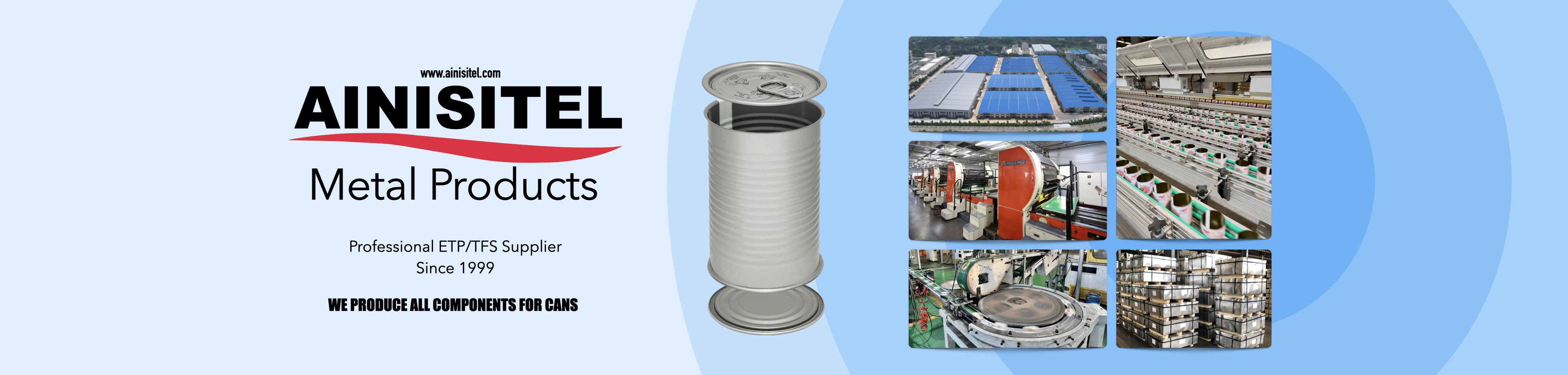
5. AINISITEL (Changzhou Ainisitel Metal Products) — The One-Stop Option for Export Buyers
Why a 20,000-tonne converter sits at #5 on a list of million-tonne mills: because most buyers outside China do not need a mill. They need 20–200 tonnes of sheet, printed to their artwork, with matching ends, shipped in one container on one date. That is a different business, and the mills above largely do not do it.
Founded in 1999 and family-owned, AINISITEL runs two factories in Changzhou, Jiangsu — about 40 minutes from Shanghai by high-speed train. The operation is deliberately built around the full chain rather than one step:
Cutting: 10 automatic coil cutting lines, 25 different scroll die shapes, annual output of 20,000 tonnes of tinplate sheet
Printing: 6 lines of 5-colour, 4-colour and 2-colour machines imported from FUJI, Japan
Coating: 6 coating lines, double-side coating capability
Lamination: an advanced lamination line producing durable, laser-effect finishes
Can ends: 6 can-end lines covering sizes 200, 202, 209, 211, 214, 300, 307, 401, 502 and 603
Can making: 2 lines from Taiwan, diameters 52–65 mm
Published specification range: thickness 0.15–0.50 mm (±0.01 mm), width 300–985 mm (0/+3 mm), cut length 450–1,150 mm, coil ID 420/508 mm, coil weight 5–10 MT, tin coating 1.1–11.2 g/m², tempers T1–T5 and DR8–DR9, surface Bright / Stone / Silver / Matte, standards GB/T 2520, JIS G 3303, ASTM A623M and EN 10202.
The practical difference for a buyer in Malaysia, Nigeria, Saudi Arabia or Ecuador is fewer handoffs: the coil, the printing, the coating, the ends and the can body come from one supplier, on one set of tolerances, with one set of loading photos. When a colour drifts, there is no argument between the printer and the material supplier — it is the same company.
And one advantage none of the other nine factories on this list can match: inventory. AINISITEL keeps roughly 10,000 tonnes of tinplate sheet in stock at its Changzhou warehouses at all times — common thicknesses, tempers and tin coating weights, ready to print, coat, cut or ship. Every mill on this list starts your order at the tinning line and quotes you a production schedule in weeks; with AINISITEL, an in-stock specification can be loaded into a container in as fast as 3 days. When a canning line is waiting on material, three days versus three weeks is the difference between filling orders and losing customers.
Strengths: small and mixed orders, fast response, in-house printing and coating, ends and cans matched to the sheet, export documentation experience across Asia, Africa, the Middle East and South America — and, uniquely on this list, a standing inventory of ~10,000 tonnes of sheet that enables dispatch in as fast as 3 days.
Limitations: not a steel mill — base coil is purchased from Chinese mills, so it cannot match Baosteel on 1,000-tonne commodity pricing, and very high-end DI material is outside its range.
6. HBIS Group
Hebei Iron & Steel is a top-five Chinese steel group with tinplate lines in Tangshan and Handan. Its tinplate business follows the same pattern as Angang: broad general-grade coverage, competitive pricing, strong domestic distribution, and less emphasis on the highest food-grade certification tiers.
For buyers running standard three-piece cans for non-acidic products, or chemical and paint containers, HBIS is a volume-safe choice. Ask specifically which base grade and which passivation you are being quoted — the range within one mill's catalogue is wide.
7. WISCO (Wuhan Iron & Steel, China Baowu)
The Wuhan arm of China's largest tinplate network.
WISCO merged into China Baowu in 2016, and its Wuhan Qingshan base is one of the three production sites behind Baosteel's roughly 800,000-tonne-per-year tinplate platform (#1). What makes WISCO worth a separate entry is its joint venture with Nippon Steel — WISCO-Nippon Steel (Wuhan) — dedicated specifically to high-end food-grade tinplate: the segment where coating integrity and tin-layer control decide whether a milk-powder can survives a two-year shelf life.
For buyers, the practical takeaway: if your specification calls for premium food-grade ETP and your volumes justify a mill relationship, the Wuhan base offers Japanese-standard food-grade material inside the Chinese supply chain — shorter logistics than importing Japanese tinplate, with Nippon Steel's process discipline behind it.
Strengths: high-end food-grade focus via the Nippon Steel JV, Baowu-scale logistics, Wuhan location for central and south China.
Limitations: high MOQ and quarterly scheduling typical of a mill; small printed or coated orders are routed to converters.
8. Baosteel Packaging (Shanghai Baosteel Packaging)
A listed packaging group (601968) that takes Baowu substrate and turns it into two-piece cans, ends and printed tinplate sheet. 2025 revenue was approximately RMB 8.49 billion, with can output of about 17.5 billion units.
Its advantage is material certainty: the substrate comes from its own group, so thickness and hardness consistency are predictable, which matters for high-speed can lines. It is also active in chrome-free passivation and water-based internal coatings.
Best for: brand owners who want cans and printed sheet from one certified supplier, and who value material traceability over the lowest quotation.
9. Masteel (Maanshan Iron & Steel, China Baowu)
The East China substrate specialist inside the Baowu network.
Masteel became a China Baowu subsidiary in 2019 and operates at roughly a 20-million-tonne steel scale from Ma'anshan, Anhui — close to both the Yangtze River ports and East China's dense food-packing cluster. Its tinplate story is newer than Baosteel's but technically deliberate: in 2014 the mill set up a dedicated APQP project team for electro-tinned substrate, and by 2015 its first food-grade tinplate substrate for anti-bend bottle caps passed stamping trials on the first attempt — the customer immediately doubled its order.
Today Masteel is the anchor tinplate producer in Anhui, where provincial tinplate-coil output grew from roughly 50,000 tonnes in 2016 to over 200,000 tonnes by 2021. For buyers, that means a competent, cost-positioned source of food-can substrate, closure (crown cap) stock and general ETP, shipped from East China ports without the Baoshan queue.
Strengths: East China location, closure and food-can substrate focus, Baowu system quality, competitive pricing.
Limitations: shorter high-end food-grade track record than Baosteel or Shougang Jingtang; printing and coating are downstream converters' business.
10. Fujian Ton Yi Tinplate (福建统一马口铁)
The Taiwan-invested veteran of South China.
Founded in March 1995 in Zhangzhou, Fujian, Fujian Ton Yi Tinplate is a large foreign-invested joint venture built by Taiwan's Uni-President group with a total investment of USD 232 million (reported registered capital USD 86.5 million; some sources also list Japanese JFE trading partners among the investors). It produces quality ETP for food cans and three-piece beverage cans, with reported capacity in the 150,000–200,000 tonnes-per-year range depending on the source, plus a TFS (chrome-coated) line added in 2005.
Its printing capability is real, not nominal: since 2000 the plant has run a Fuji PRIMEX-P452 two-colour printing press, a Fuji C452 quick coater and German KBA oven equipment for coated and printed sheet. Products serve the domestic market, with part of the output exported.
Strengths: nearly 30 years of operation, Taiwan management and quality culture, printing and coating on site, Fujian port location for Southeast Asia.
Limitations: single-base operation; export share and ultra-thin or DI grades are smaller or outside its range compared with the northern mills.
Buyer's Checklist: Nine Questions Before You Send a Deposit
Am I buying from a mill, a converter, or a trader? Ask for the base coil mill name and the coil certificate. A converter quoting "our own steel" is a red flag unless it truly owns a mill.
Which standard governs the order? GB/T 2520, JIS G 3303, ASTM A623M and EN 10202 are not interchangeable. Name one in the contract.
What is the actual temper, not the trade name? T3 in one mill's catalogue is not always T3 in another's. Ask for yield strength and hardness values.
Which passivation — 300 or 311? It changes paint adhesion and corrosion behaviour.
Is the tin coating equal or differential? Differentially coated material is cheaper but only correct for specific applications.
Who inspects, and what is recorded? Ask for per-process QC records — coil number, coating weight test, print colour proof.
What is the real lead time, including printing? Unprinted sheet can ship in days; six-colour printed sheet with a new die needs artwork approval, proofing and press scheduling.
How is it packed for sea freight? Seaworthy wooden pallet, edge protection, desiccant, and a container loading photo set.
What happens if the coating weight is out of spec? Get the remedy — replacement, credit or discount — in writing before production.
2026 Price Context
Two cost drivers moved sharply in 2026: tin ingot prices rose by roughly 50% year on year in the first half, and hot-rolled substrate prices followed steel mill policy. The result is that quoted prices are valid for shorter windows than they were in 2023–2024 — most Chinese suppliers now hold prices for 7–15 days, not 30. If a supplier offers a 60-day validity on a tinplate quotation in this market, ask what happens when tin moves again.
Export volume tells the other half of the story: China's tinplate exports grew about 16% in 2025, then turned negative in the first half of 2026 as overseas buyers drew down inventory. For buyers, that means suppliers are hungrier than the headline capacity number suggests — negotiate.
Looking for a Reliable Tinplate Supplier in China?
From tinplate and TFS coils to precision-cut sheets, printed and coated materials, easy-open ends and tin cans, AINISITEL provides integrated metal packaging processing services for overseas buyers.
Share your required thickness, temper, coating weight, dimensions, printing artwork, quantity and destination port. Our team can help you evaluate the suitable processing solution and prepare a quotation.
Send Your InquiryLearn About AINISITELFrequently Asked Questions
1. Who is the largest tinplate manufacturer in China?
Baosteel (China Baowu) is the largest electrolytic tinplate producer, with design capacity of roughly 800,000 tonnes per year and a focus on high-end food and beverage packaging.
2. What is the difference between a tinplate mill and a tinplate converter?
A mill produces the coated steel coil from hot-rolled substrate. A converter buys that coil and cuts, prints, coats, laminates or stamps it into sheets, ends and cans. Most export orders below a few hundred tonnes are served by converters.
3. How much does Chinese tinplate cost in 2026?
Prices move with tin and substrate costs and with grade. Commodity ETP and TFS sit in a broad band; printed or lacquered sheet adds a per-tonne processing premium that depends on colours, coating type and order size. Always request a quotation against a named specification — a per-tonne figure without thickness, temper and coating weight is not comparable.
4. What is the minimum order for printed tinplate from China?
It depends on the process. Unprinted sheet can often ship from stock in small volumes; printed sheet usually requires a minimum run per colour set because of press set-up, and a new die adds a one-off cost. Ask for MOQ by process, not as a single number.
5. Which Chinese suppliers export to Southeast Asia, Africa and the Middle East?
Yuehai Zhongyue, Fujian Ton Yi and AINISITEL all have established export flows into these regions, with container loading out of Guangdong, Fujian and Jiangsu/Shanghai respectively.