
Custom Printed Tinplate from China: 5-Color Fuji Printing, MOQ & Design Guide
 Nov 23, 2026|
 View:13
Quick answer: The practical MOQ for custom printed tinplate in China is typically 3–5 tonnes per artwork design on a standard sheet size, because that is what a single press pass requires. AINISITEL operates 6 printing lines built on 5-colour Fuji printing machines imported from Japan, plus 6 coating lines for single- and double-side lacquering. With roughly 10,000 tonnes of base tinplate in stock, an approved artwork on an in-stock substrate can move from file review to dispatched sheets in as fast as 3 days; standard production lead time is within 15 days.
Key Takeaways
Custom printed tinplate typically carries a 3–5 tonne MOQ per artwork on a standard sheet size; exact minimums vary by supplier, sheet size and colour count.
A one-stop print, coat and cut factory removes inter-plant freight and keeps colour accountability inside one QC chain.
Press-ready files need vector artwork, outlined fonts, Pantone spot colours and the can maker's dieline, followed by a signed physical proof.
Standard production lead time is stated as within 15 days, while stock-substrate jobs are described as dispatchable in as fast as 3 days.
Every metal can you have ever opened — a paint tin, a biscuit gift box, an easy-open coffee can — started as a flat sheet of tinplate that passed through a printing press and a coating line before it was cut and formed. That decorating step is where most of the visual value of metal packaging is created, and it is also where buying decisions quietly add or remove 10–20% from total cost.
This guide explains how custom printed tinplate is actually produced in China, what design files a printing plant needs from you, what minimum order quantities to expect, and how the sampling process runs. It is written for packaging buyers, can factories and brand owners sourcing decorated tinplate for the first time — or re-sourcing it because a two-vendor setup has started to hurt.
Disclosure: this guide is published by AINISITEL, a tinplate service factory in Changzhou, China, operating since 1999 with 6 printing lines, 6 coating lines and 10 shearing lines. Industry-wide figures in this article (typical MOQ ranges, sampling timelines) are hedged as “typically” and vary by supplier — treat them as planning references, not quotes.
Why Buying Printed Tinplate Direct from a Factory Costs Less
The traditional sourcing route for decorated metal packaging is a two-vendor chain: buy plain tinplate sheet from a trader or mill, truck it to an independent decorating plant, then truck it again to your can maker or your own production line. Each handoff adds a margin, and each handoff adds a point where quality accountability breaks.
Consider what happens when the colour drifts on batch three. With two vendors, the decorator blames the base sheet's surface roughness; the sheet supplier blames the decorator's ink formulation and oven temperature. You are the referee, the freight between plants is your cost, and the re-run delay is your lost selling season. With a one-stop factory, the substrate, the coating, the ink and the oven are the same company's responsibility — there is no argument to win, only a correction to make.
| Cost / risk factor | Separate trader + decorator | One-stop factory (print + coat + cut) |
|---|---|---|
| Vendor margins | Trading margin + decorating margin stacked on the same material | Single margin; decorated price quoted ex-works |
| Inter-plant freight | Two to three additional inland legs per order | None — coil enters, decorated sheets exit |
| Colour-drift accountability | Split between sheet supplier and printer | One QC chain from coil to final sheet |
| Substrate / coating compatibility | Decorator must guess or re-test the base sheet's lacquer system | Coating specified together with substrate at order stage |
| Double handling / re-inspection | Sheets re-checked and re-packed at every handoff | Inspected once, packed to export standard |
| Small-order flexibility | Decorator prioritises large can-group contracts | Service factories exist to take mixed, smaller export orders |
None of this means independent decorators are bad at printing. Some are excellent. It means that for an export buyer without a local technical team, one factory that owns the coil, the press, the coater and the shearing line is the simpler contract to manage — and usually the cheaper one once freight and re-runs are counted.
Need Printed and Coated Sheet for Your Line?
Review the press and coating configuration, sheet specifications and quotation route for a decorated-sheet order.
Inside the Printing Hall: 5-Colour Fuji Presses from Japan
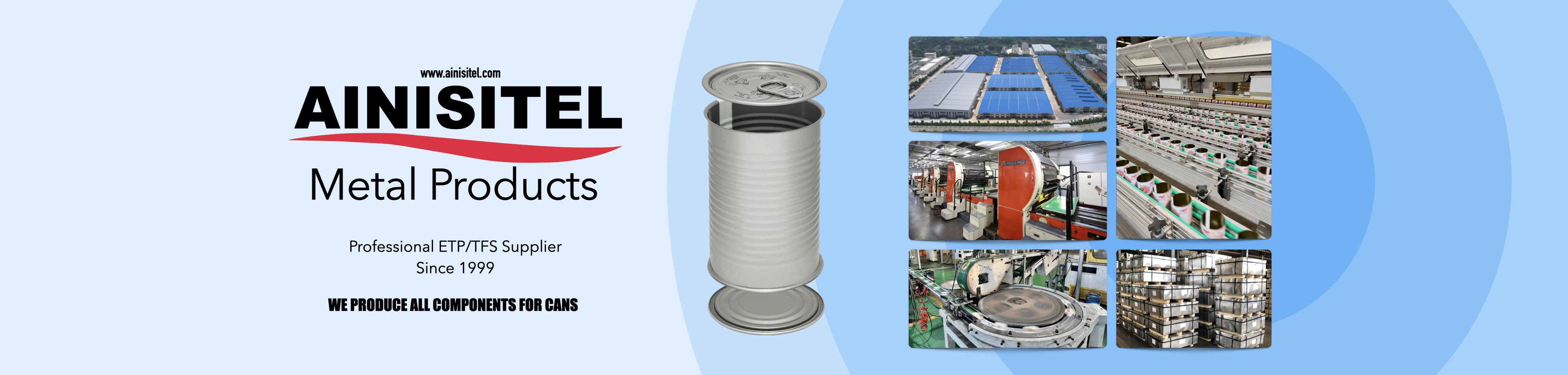
AINISITEL operates 6 printing lines — 5-colour, 4-colour and 2-colour configurations — built on Fuji printing machines imported from Japan, supported by 6 coating lines that apply internal lacquers and external varnishes to one or both sides of the sheet. Fuji metal-decorating presses are widely used equipment in Asian tinplate printing: they are built to hold colour-to-colour registration across long production runs, which is a key technical factor behind whether a photorealistic image on a curved can looks premium or cheap.
What does “5 colours” mean in practice for your artwork? The most common builds are:
White base + four decorative inks — the standard recipe for photorealistic food and gift packaging, where the white underlayer makes every other colour read true.
Five spot inks — brand-critical packaging that must match exact Pantone references (a corporate red, a specific gold) rather than process-colour approximations.
Spot inks + effect varnish — four colour inks on the press, with the fifth unit laying a matte, gloss or textured varnish to create contrast finishes on a single pass.
| Item | AINISITEL specification |
|---|---|
| Printing lines | 6 lines — 5-colour / 4-colour / 2-colour Fuji presses (imported from Japan) |
| Coating lines | 6 lines, single-side or double-side lacquering and varnishing |
| Sheet thickness | 0.15–0.50 mm (±0.01 mm) |
| Sheet width | 300–985 mm |
| Steel substrate | MR / L / D grade tinplate (ETP) and TFS |
| Tempers | T1–T5; DR8–DR9 for double-reduced high-strength jobs |
| Tin coating weights | 1.1–11.2 g/m² (equal and differential) |
| Surface finishes | Bright, stone, silver, matte |
| Downstream | 10 shearing lines, 25 shear die profiles; EOE lines for sizes 200–603; can lines for 52–65 mm diameters |
| Standards | GB/T 2520, JIS G3303, ASTM A623M, EN 10202 |
Double-side coating deserves a separate sentence, because it is where inexperienced decorators cut corners. Food and chemical packaging needs a corrosion-resistant internal lacquer tuned to the product (acidic fruit, oily fish, solvent-based paint all attack differently), while the external face carries the print and varnish. Running both faces on controlled coating lines — rather than outsourcing one side — keeps the two systems compatible at the sheet edges, where corrosion failures start.
Beyond ink printing, commonly requested effect finishes include matte-and-gloss contrast, wrinkle (crackle) lacquer and pearlescent effects; for applications that demand abrasion and deep-forming durability, lamination film on tinplate is the higher-durability alternative to conventional coating, and that trade-off is covered in a dedicated article.
Design File Requirements: What to Send and What to Avoid
Metal decorating is offset printing onto steel — the file standards differ from paper printing, and most first-order delays trace back to artwork, not to press availability. Send the following and your proof cycle shortens immediately:
Vector source files — Adobe Illustrator (.ai) or press-quality PDF. Raster files (JPG/PNG) can be printed but cap your image quality; if photographs are unavoidable, supply them at 300 dpi or better at final print size.
Fonts converted to outlines — avoids font-substitution errors on a machine unfamiliar with your typeface.
Colours specified as Pantone (PMS) spot colours — avoid RGB or unmanaged CMYK. On tinplate, spot inks are how a brand colour survives; state clearly which elements sit on the white base and which inks print directly on metal.
The dieline from your can or lid maker — not a guess. The sheet layout is built around the body blank, the lid and the seam allowances; a wrong dieline invalidates every other correct decision in the file.
Bleed and safety margins respected — artwork that runs to the trim edge needs bleed beyond the cut line; text and logos kept clear of curl edges and seam zones, which will be wrapped or welded out of view.
Minimum line weights and reversed-out text limits — hairlines and small white type on dark fills are the classic metal-printing failure; keep fine detail above the press's reliable minimum (your artwork review will flag these).
Overprint and knockout intentions marked — black overprint usually prints cleaner than knocked-out black on multi-unit presses.
A physical proof approval, not a screen approval — sign off on printed tinplate sheets, not on a PDF. Metal changes ink appearance versus paper; the proof sheet is the contract.
| Common artwork mistake | What happens on press | Fix before submitting |
|---|---|---|
| RGB colours left in the file | Colours shift unpredictably at separation | Convert all fills/strokes to Pantone spot |
| No white-base layer specified | Inks print directly on grey metal; colours look dull and dirty | Mark white-base areas explicitly (usually full external face) |
| Dieline drawn by guesswork | Artwork misaligned with body blank; seam cuts through logo | Request the official dieline from your can maker first |
| Hairline strokes under 0.2 pt | Lines break up or disappear in registration | Set minimum stroke weight; convert hairlines to 0.25 pt+ |
| Fonts not outlined | Wrong font substituted; text reflows | Create outlines before export |
AINISITEL's pre-press team reviews incoming artwork against the press and dieline before anything is imaged, and returns a marked-up checklist rather than a silent re-confirmation — the review step exists to protect your launch date, so treat its questions as free engineering, not bureaucracy.
MOQ, Sampling and Lead Time
Why does printed tinplate have an MOQ at all? Because decorating is a setup-driven process: each artwork needs plates imaged and mounted, inks mixed and matched, and the press run configured before the first good sheet appears. That setup cost is fixed, so it must be spread across the run — which is why the industry's practical minimum for a custom printed design typically lands at 3–5 tonnes per artwork on a standard sheet size (exact figures vary by supplier, sheet size and colour count).
| Product type | Typical MOQ (per design/size) | Notes |
|---|---|---|
| Custom printed tinplate sheet | Typically 3–5 tonnes | One press pass per artwork; multiple artworks can share one base-sheet run |
| Plain / coated-only sheet (no print) | Lower — coating-only setups are simpler | Internal lacquer or gold varnish without decorative print |
| Easy-open ends (EOE) | Per size, from 200 to 603 | Tooling exists in-house; MOQ scales with end size |
| Made cans (52–65 mm) | Per size and construction | Two-piece/three-piece lines from Taiwan |
| Stock-cut plain sheets | Lowest — cut from ~10,000 t standing inventory | No print setup; dispatch possible in as fast as 3 days |
The sampling process, step by step:
Artwork and spec review — you send AI/PDF artwork, the substrate spec (temper, thickness, tin coating, surface) and the dieline; the factory returns a technical checklist and a quotation.
Colour targeting — Pantone references are confirmed against physical ink drawdowns on the actual substrate, because the same ink reads differently on bright versus stone-finish tinplate.
Proof sheets printed — a short run on the production press (not a digital mock-up) produces real decorated sheets. Typical timing depends on artwork readiness and queue position.
Proof approval — you inspect the physical sheets (or approve against detailed photos if distance forces it) and sign off the colour, gloss and finish.
Mass production — printing, double-side coating, curing and shearing to size, with in-line and offline QC at each stage.
Export packing — sheets palletised in export-grade seaworthy packing for container loading.
Dispatch and tracking — booking, container loading with photo records, and shipping documents to your forwarder.
Lead time: AINISITEL's standard production lead time for printed and coated orders is within 15 days. The inventory advantage matters most on repeat and simple jobs: with roughly 10,000 tonnes of tinplate sheet held in stock, an approved artwork on an in-stock substrate can be printed, cut and dispatched in as fast as 3 days — no waiting for the mill's production schedule. Payment terms are 30% deposit with balance against a copy of the bill of lading for orders of USD 1,000 and above, or sight letter of credit.
Application Examples: Paint Cans, Gift Tins and Beverage Cans
The same 6 lines serve three very different print briefs, which is why a mixed book of orders keeps the presses busy and prices competitive:
| Application | Typical print & coat spec | Why factory-direct matters here |
|---|---|---|
| Paint & chemical pails/tins | 1–2 spot colours + brand varnish outside; chemical-resistant internal lacquer inside | Internal lacquer system must match solvent content; one factory specifies both faces together |
| Gift & biscuit tins | Full 4–5 colour photorealistic print + white base + matte/gloss or wrinkle effect finishes | Effect varnish runs on the same pass as inks; seasonal designs need flexible MOQ and fast proofs |
| Food & beverage cans/ends | Brand print on body stock; matched easy-open ends in sizes 200–603; food-grade internal lacquer | Printed sheet + EOE + can body from one supplier keeps the lacquer system consistent end to end |
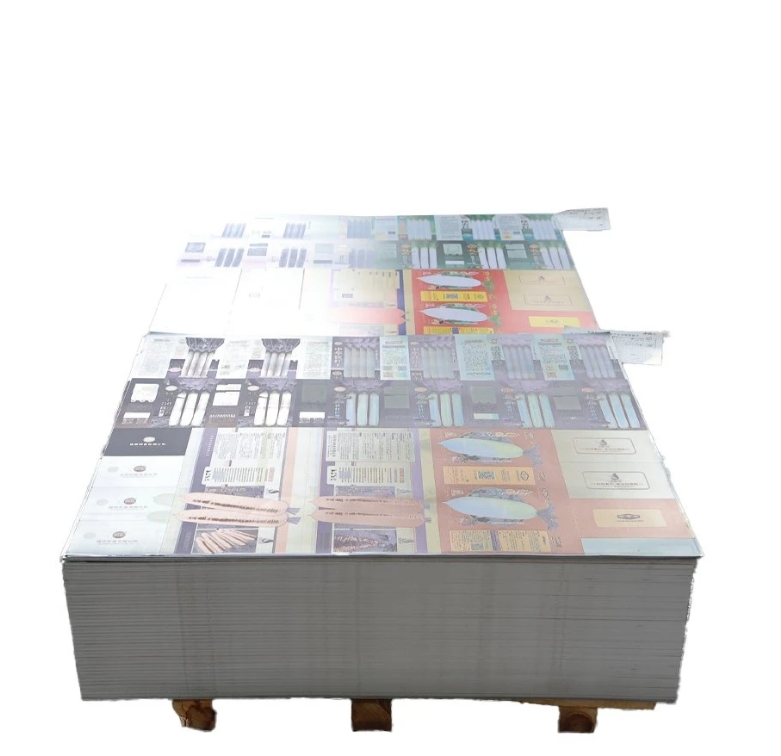
The decorated sheet and matched end components below reflect two of the formats most often specified in these applications.

Printed Tinplate Sheet
Offset-printed tinplate sheet for cans, lids and decorative packaging.
View Product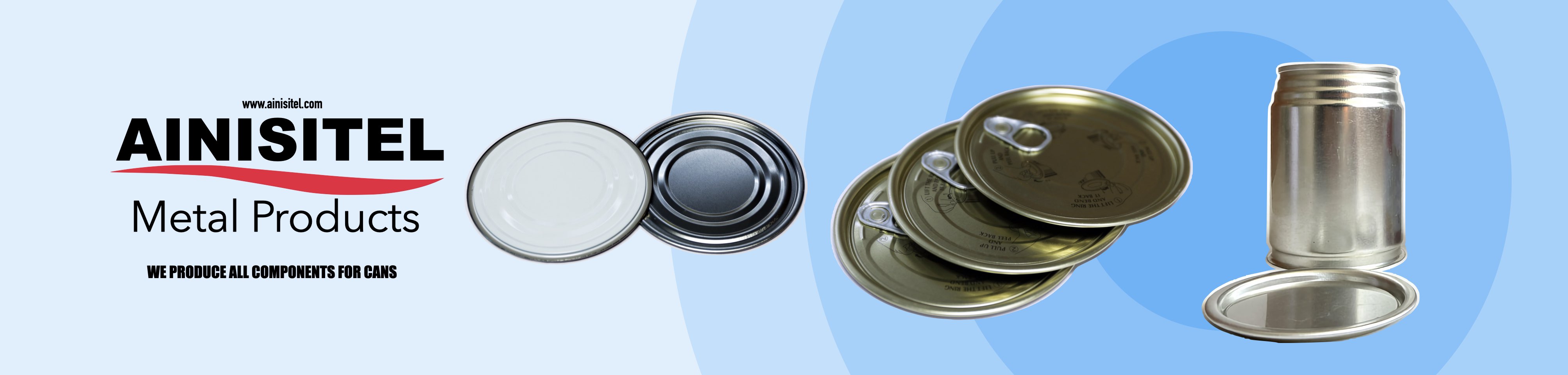
Match Sheet, Ends and Can Body in One Specification
Request samples, review custom printing options or read background guidance before placing a decorated-sheet order.
Paint cans are the volume anchor: high-quantity, colour-critical on one or two inks, and unforgiving on internal lacquer because solvent-based products attack weak coatings within months on the shelf. Gift tins are the showcase: five-colour builds, effect varnishes and tight seasonal deadlines reward factories that hold sheet stock and can proof quickly. Food and beverage is the compliance-heavy end: food-grade internal lacquers, standards conformance (GB/T 2520, JIS G3303, ASTM A623M, EN 10202) and matched easy-open ends — and it is the segment where buying printed body sheet, ends and cans from a single supplier prevents the classic mismatch of a lid lacquer fighting a body lacquer at the double-seam.
Frequently Asked Questions
What is the MOQ for custom printed tinplate?
Typically 3–5 tonnes per artwork design on a standard sheet size, because each design requires its own plates, ink matching and press setup. Coating-only orders (no decorative print) carry lower minimums, and stock-cut plain sheets are available with no print setup at all. Exact MOQ depends on sheet size, colour count and specification — send your artwork and spec for a firm quote.
What artwork files do you need for tinplate printing?
Vector files (Adobe Illustrator or press-quality PDF) with fonts converted to outlines and colours specified as Pantone spot references, plus the official dieline from your can or lid maker. Photographic elements should be supplied at 300 dpi or better at final size. Every order includes a pre-press artwork review before plates are imaged.
Can you match an exact Pantone colour on tinplate?
Yes — spot inks are mixed and verified against physical drawdowns on your actual substrate before the proof run, because the same ink reads differently on bright, stone, silver or matte surfaces. The proof sheet you approve becomes the colour contract for mass production.
How long does printing and coating take?
Standard production lead time is within 15 days from proof approval. Because AINISITEL holds roughly 10,000 tonnes of tinplate sheet in stock, an approved design on an in-stock substrate can be dispatched in as fast as 3 days — mill-sourced orders that wait for base material production take longer.
Printed tinplate or laminated steel — which should I choose?
Choose conventional printing when you need photorealistic artwork and broad colour options at a competitive unit cost. Choose lamination when the forming process is aggressive or the surface must survive abrasion — film laminates offer higher durability and can include laser-style effects. Many programmes use both: printed body stock, laminated high-wear components.
What standards do your printed and coated sheets meet?
Production follows GB/T 2520 (China), JIS G3303 (Japan), ASTM A623M (USA) and EN 10202 (Europe), covering tinplate and TFS substrate grades, tempers T1–T5 and DR8–DR9, tin coating weights of 1.1–11.2 g/m², and thicknesses of 0.15–0.50 mm. Every production stage carries QC inspection, with photos available through production, loading and shipping.
Start a Printing and Coating Enquiry
Submit artwork for review, learn about the factory or browse matched can-end formats.
References and Notes
Background on tinplate composition and manufacture — supports the description of tinplate as coated steel sheet (en.wikipedia.org, accessed 2026-11-23).
Overview of metal can construction and uses — supports the opening statement about cans starting as flat sheet (en.wikipedia.org, accessed 2026-11-23).
Background on the offset lithography process — supports the description of decorating as offset printing onto steel (en.wikipedia.org, accessed 2026-11-23).
General requirements specification for tin mill products — confirms ASTM A623M as a current tin mill products standard (store.astm.org, accessed 2026-11-23).
Data notes: the 3–5 tonne MOQ, roughly 10,000 tonne stock figure, 3-day dispatch and 15-day lead time are industry planning ranges or manufacturer-stated figures, not quotations. Thickness 0.15–0.50 mm, tin coating 1.1–11.2 g/m², tempers T1–T5 / DR8–DR9 and the four cited standards are consistent across independent industry references. Manufacturer materials variously describe the press fleet as 5-colour and 6-colour configurations, so colour count should be confirmed per line.
Internal links: the supplied text contained no hyperlinks, so there is no original internal-link baseline. All internal targets above were added as anchor text and verified as live pages on ainisitel.com.