
How to Choose a Reliable Tinplate Supplier in China
 Oct 15, 2026|
 View:44

One bad batch of tinplate can stop your production line, ruin finished cans, and force expensive rework. You avoid that result by checking suppliers in a careful, step-by-step way, not by comparing prices. A planned approach turns a risky purchase into a controlled decision.
You get six evaluation areas: certifications, quality consistency, capacity, technical support, sustainability, and reputation. Each area gives you a clear test. You can run every test before you commit to a tinplate supplier.
Treat each area as a checkpoint. Check certifications first. Check consistency next. Confirm capacity, then support, sustainability, and reputation. This order protects your budget and your delivery schedule.
Key Takeaways
First, check the certifications to make sure food safety and quality systems are in place.
Check samples from every batch to make sure the coating and thickness stay the same.
Check the supplier's actual production capacity, and plan lead times with extra stock on hand.
Pick a supplier that gives quick technical help and fixes problems fast.
Check how they protect the environment, and ask for names of other companies they have worked with in your field.
Certifications of a Genuine Manufacturer
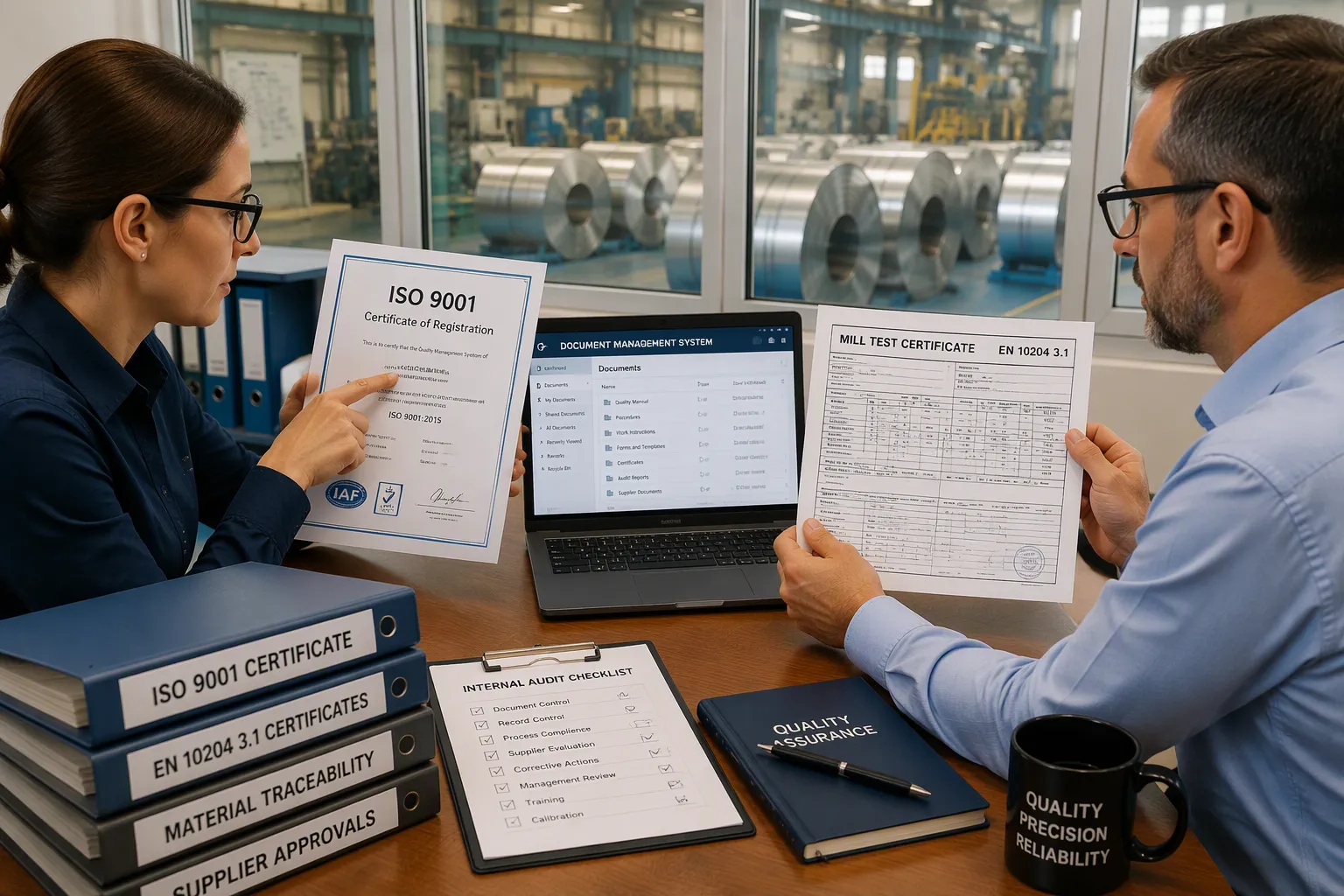
A real manufacturer writes down its processes and proves them with outside audits. Strong quality control systems turn good plans into the same result every time. Ask for the paperwork before you talk about price. Certificates show how a plant runs its lines, trains its staff, and handles a complaint.
Key Certifications to Verify
Start with three groups: food-grade compliance, quality management systems, and material traceability. A quality management system certification like ISO 9001 covers written process control, internal audits, corrective action, and complaint handling. It is a claim about process, not about product safety. Food-safety certifications go further. ISO 22000 adds HACCP-based hazard analysis, verification, and traceability. BRCGS and FSSC 22000 carry GFSI recognition and often show up on European brand-owner specs for food-contact packaging. Food safety compliance also requires a declaration of conformity and, where relevant, migration testing under rules like Regulation (EC) No 1935/2004. Match the certificate set to your destination market. European buyers expect a food-contact compliance trail first, then a GFSI-recognised scheme. North American buyers rely on food-contact substance compliance and their own brand-owner audit programs, with food safety compliance running alongside. Asian buyers usually make food safety and brand protection the top priority. A reliable suppliers shortlist shows certificates that fit your market, not one universal stack. Ask each candidate for its declaration of compliance, its GMP confirmation, and its latest migration and heavy metal test reports. Those documents support food-grade quality assurance better than a logo on a brochure. A certificate that expired last year tells you little about current practice.
Reading Mill Certificates
A mill test certificate (MTC) links each lot to measured values. Request an MTC EN 10204 3.1 and read it line by line. Check the steel grade: SPCC, MR, 08AL, or SPTE. Confirm the tin coating weights against the nominal values on the certificate. Verify the thickness range against your order. Confirm the temper class and the coating mass tolerance so your incoming inspection uses the same criteria. Look for heat, coil, and slit-strip lineage. Mill traceability lets you trace a welding deviation back to its source fast. Check that the certificate cites a recognized standard such as ISO 11949/EN 10202, ASTM A623, or JIS G 3303. These standards define classification, mechanical properties, thickness tolerances, and coating weight test methods. Reputable suppliers back the MTC with in-house inspection of thickness, coating mass, tensile strength, T-bend, salt spray, and surface roughness. Third-party inspection from firms like SGS, BV, or TÜV is available on request. For coating weight, the Constant-Current Electrolytic Test Method serves as the referee method and measures one side at a time, which suits differential tinplate. Compare two or three lots side by side to spot drift in coating weight or thickness. Reputable producers such as Baosteel, Wuhan Iron & Steel, Nippon Steel, and Shougang set market benchmarks for these values. Treat those names as context, not endorsement. Strong quality control measures show up in the documents, and weak ones hide behind vague claims. A tinplate supplier that cannot produce a clean MTC on request will struggle to support your quality assurance program later.
Quality Consistency from a Reliable Chinese Tinplate Sheet Supplier
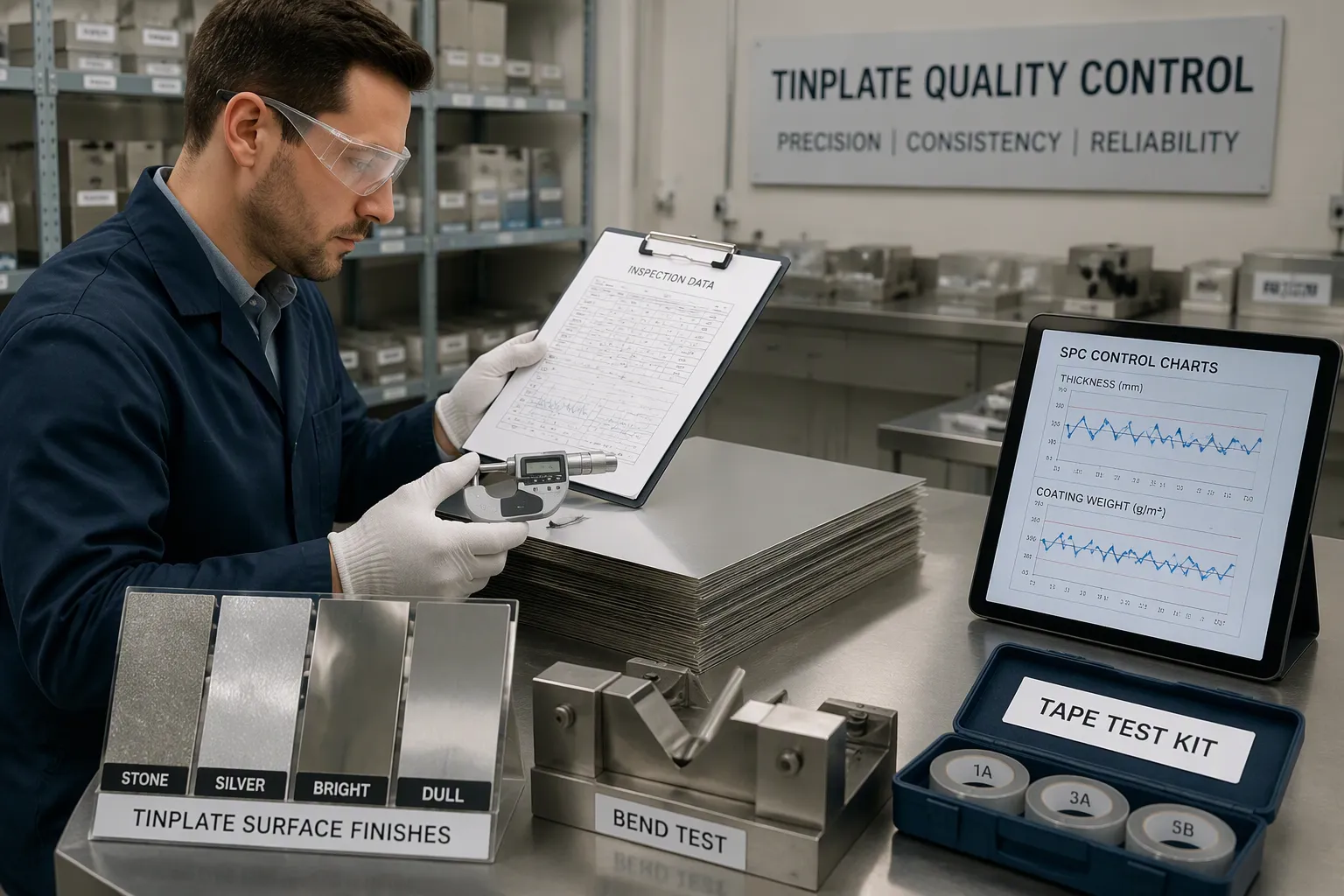
Consistency is what makes a reliable chinese tinplate sheet supplier different from a trader with nice photos. You need lot ten to have the same coating weight, gauge, and hardness as lot one. Ask for process capability data on thickness, tin coating weight, and temper. That data shows how tightly the plant controls each parameter. Look at trends across several batches. A steady trend lowers your risk of line stoppages.
Coating, Thickness, and Temper Checks
Start with surface finish. Bright, stone, silver, and matte finishes each fit different end uses, and a mixed shipment will show up in your printing quality. Next, confirm hardness. T1 through T5 cover single-reduced grades, while DR7m, DR8, DR9, and DR10 cover double-reduced stock. Softer tempers like T1 and T2 work well for deep drawing. Harder grades like T4, T5, and DR8 give larger containers the strength they need. A wrong temper causes defects, so match the grade to your can design.
Then test coating adhesion. Bend, cupping, and tape tests show whether the lacquer will flake during forming. Weak coating adhesion ruins printed tinplate sheets after decoration. Check thickness tolerances against your seamer and welder windows, and confirm both average and single-spot limits. Verify tin coating mass per side, equal or differential, against your lacquer stack and weld settings.
SPC Method | Purpose |
|---|---|
Control charts | Track dimension stability and seam quality across shifts |
Check sheets and Pareto charts | Rank defect counts to direct resources |
Cause-and-effect diagrams and 5 Whys | Find the root cause of recurring coating or printing failures |
AQL sampling | Hold consistency at final batch release |
The supplier pairs advanced ETP/TFS production with automated quality control to steady thickness, coating weight, and surface finish—the exact levers that govern score and openability.
Sampling with AINISITEL's ETP/TFS Process
Follow a fixed workflow before you commit to a bulk order:
Share your specification, including grade, temper, coating weight, and finish.
Confirm return samples and test them against that specification.
Run a pilot batch and compare measurements from batch to batch.
Scale up with statistical controls in place.
AINISITEL shows how a real manufacturer handles this. The company gets raw materials from Baosteel, runs 10 modern tinplate coil cutting lines, and does in-house quality inspection at every stage. Its ETP/TFS line keeps more than 10,000 metric tons of prime stock, so you can compare batches from live inventory. Treat this as one example, not the only option. Ask every candidate for the same evidence, and confirm batch verification before you release a bulk order. Strong quality control here protects the quality of the tinplate you receive, and it supports your own quality assurance program. For printed tinplate sheet orders, ask for a press proof and a coating adhesion report together, so printing and lacquer performance are judged as one system.
Capacity and Lead Times of Chinese Tinplate Suppliers
Assessing Real Production Capacity
Ask three questions before you trust a capacity claim: What is your yearly output? How much prime stock do you keep? How many lines run each shift? Big chinese tinplate suppliers like to publish large numbers. The table below shows how big the major producers are, so you can judge whether a claim fits the market.
Manufacturer | Annual Production Capacity (tinplate-related) |
|---|---|
Zhongshan Zhongyue Tinplate Industry Co. Ltd | 240,000 t tinplate/chromium-plated sheets; 20,000 t coated iron; 150,000 t tinplate substrate |
Zhongyue POSCO (Qinhuangdao) Tinplate Industry Co. | 250,000 tonnes tin-plated thin steel sheets |
Fujian Unity Tinplate Co., Ltd. | 180,000 t initially; +150,000 t added line |
Zhangzhou Unity Tinplate Co., Ltd. | 150,000 tonnes high-quality tin-plated thin steel sheets |
Guangzhou Pacific Tinplate Co., Ltd. | Single unit >150,000 t/a |
AINISITEL gives you a helpful benchmark. The company runs two factories in China and makes 20,000 MT of tinplate sheet a year. It also holds more than 10,000 MT of prime ETP/TFS stock. That much inventory helps keep production steady for repeat orders.
You can find candidates through industry directories and B2B platforms such as Made-in-China and Ensun. Check every claim with a site visit or a video audit. Walk the floor, watch the equipment run, and count the staff on shift. Seeing things yourself tells you more about real production capacity than any brochure.
Lead Time and Logistics Planning
Lead time depends on your specification, not on a company-wide promise. Standard tinplate takes 5–30 days. Precision slitting and coated-strip programs take 14–25 days. AINISITEL usually ships within 15 days after deposit, which falls inside that range.
Shipping delays — Red Sea disruption adding 10–15 days via the Cape of Good Hope — push many buyers to hold 45–60 days of safety stock.
Plan the route early. Sea freight FCL averages 15–20 days, LCL 20–30 days, and air freight 3–5 days. Shanghai handles 450+ vessels with about 2 days of delay, while Los Angeles/Long Beach shows 110+ vessels and 25+ days of delay. Match the freight mode to volume and urgency, choose Incoterms that assign risk clearly, and use real-time tracking so contingency plans stay ready. Book warehousing near the discharge port to absorb delay shocks.
Technical Support from a Tinplate Supplier
A good tinplate supplier does more than just ship metal. The right partner helps you choose the grade, temper, and coating for your exact use. That guidance protects your can-making line and your finished product.
Responsiveness and Communication
Ask about response time before you sign. Reliable suppliers say they will answer questions fast and work closely with you to fix problems quickly. That support keeps production running and deadlines on track. Ask for details: hours of operation, a named contact, and a clear way to handle urgent issues. Confirm English-language support if your team does not speak Chinese. Follow up on samples and watch how fast the supplier replies. A slow reply during the sales phase often means slow help after the order.
Technical Guidance and Problem Solving
Strong suppliers guide material selection, formability analysis, and troubleshooting. They review can designs, assess process technology, and help you improve production. Some also help with logistics and sustainability assessments. Ask your candidate to write down the application, steel grade, thickness and tolerance, temper, coating mass per side, surface finish, and trial quantity. That detail prevents costly mismatches.
Technical Support Service | Purpose |
|---|---|
Material recommendations | Support smooth can-making processes |
Process technology assessment | Realize can-making line efficiencies |
Can design reviews | Improve can performance |
Logistics assessment | Improve supply chain performance |
Sustainability assessment | Optimize current can-making operations |
AINISITEL offers one example of one-stop support. Its experienced sales team guides grade and coating choices, and its in-house printing and coating integration saves time and cost. That setup strengthens tinplate production and printing capabilities and protects printing quality on every printed tinplate sheet. For printed tinplate sheets, ask for a press proof and a cure check together. Reliable suppliers treat printing and lacquer as one system. Order a printed tinplate sheet sample, then compare printed tinplate sheets across batches before you commit.
Sustainability and Reputation of a Tinplate Packaging Supplier
Environmental Practices to Verify
Ask for certificates of analysis that show coating weight and cure. Request adhesion and porosity test results, plus migration test summaries that match your process conditions. A coating film weight within spec plus or minus 10% controls barrier performance and seam flexibility. Cross-hatch adhesion at 4B–5B equivalent stops delamination during seaming and retort. Porosity must pass with no pinholes to avoid underfilm corrosion on long shelf life. These checks protect tinplate can manufacturing from costly rework and support food safety compliance.
Confirm that any "green" lacquer passes worst-case heat and storage profiles. Multi-polymer coatings free from bisphenol A (BPA) suit food and beverage packaging. Waterborne and high-solids systems can shrink solvent footprints. Tinplate is endlessly recyclable in established steel recovery streams, and in EU countries about 60% of tinplate products are recycled. Design-for-recycling practices keep the can fully compatible with steel recycling. A strong tinplate packaging supplier documents these points for food-grade quality assurance and steady tinplate can manufacturing.
References and Track Record
Check years in operation and manufacturing experience. Longevity signals accumulated expertise. Ask for industry-specific customer references in your own segment. Request verifiable references, current ISO 9001 and ISO 22000 certificates, heavy metal testing reports, and traceability documentation. Seek on-time delivery history and factory hygiene reports, both core to tinplate can manufacturing. A tinplate packaging supplier with 10+ years of experience and references in your industry is a green flag for tinplate can manufacturing.
AINISITEL shows one example of a tinplate packaging supplier with a broad track record. Its Can Products line covers easy-open ends, can lids, and food and beverage cans across six high-speed production lines. That range supports tinplate can manufacturing for food, beverage, chemical, and gift packaging. Compare candidates through trusted suppliers directories and cross-check claims. Buyers in china and worldwide can validate a tinplate packaging supplier this way. Solid food safety compliance and open references separate real tinplate can manufacturing partners from traders, and they keep tinplate can manufacturing reliable over the long term.
Check every supplier against the same six areas:
Certifications: food-grade compliance, quality systems, and traceability.
Consistency: coating, thickness, temper, and adhesion from batch to batch.
Capacity: real output, stock on hand, and lead times.
Support: quick answers and useful technical help.
Sustainability: recyclable material and proof of coating performance.
Reputation: references in your own industry.
Then go step by step. Start with a sample, place a trial order, and sign a long-term contract only after both pass. Keep talking openly at every stage. This step-by-step path turns a risky purchase into a reliable partnership. You now have a clear plan for a confident sourcing decision. Visit AINISITEL's website for product details and specifications.
FAQ
How do you confirm a Chinese tinplate supplier is a real manufacturer?
Ask for a video audit or a site visit. Count the cutting lines and watch them run. Request the business license, the factory address, and recent mill certificates. A real plant shows live inventory and in-house inspection records. A trader cannot show these when you ask.
Which documents should you request before placing a first order?
Collect four items: a mill test certificate for each lot, a food-contact declaration of conformity, the latest migration and heavy metal test reports, and current quality system certificates. Check the steel grade, coating weights, and thickness range against your specification. Missing paperwork is a sign of weak process control.
Can you order samples before committing to a bulk contract?
Yes. Share your full specification first, including grade, temper, coating weight, and finish. Test the return samples against that specification. Run a pilot batch and compare measurements across batches. Release the bulk order only after batch verification passes. This order of steps protects your line and your budget.
How should you handle a quality claim?
Report the problem fast and attach your inspection data. Point to the mill certificate values and your agreed specification. A reliable supplier looks into the root cause and suggests corrective action. Keep samples from the disputed lot. Clear records turn a claim into a fix, not a fight.
What is a realistic first step toward a long-term partnership?
Start small. Place a trial order at a modest volume and track delivery, measurements, and communication. AINISITEL usually ships within 15 days after deposit, which fits a trial timeline. Sign a long-term contract only after the trial passes. Open talk at each stage builds trust.